
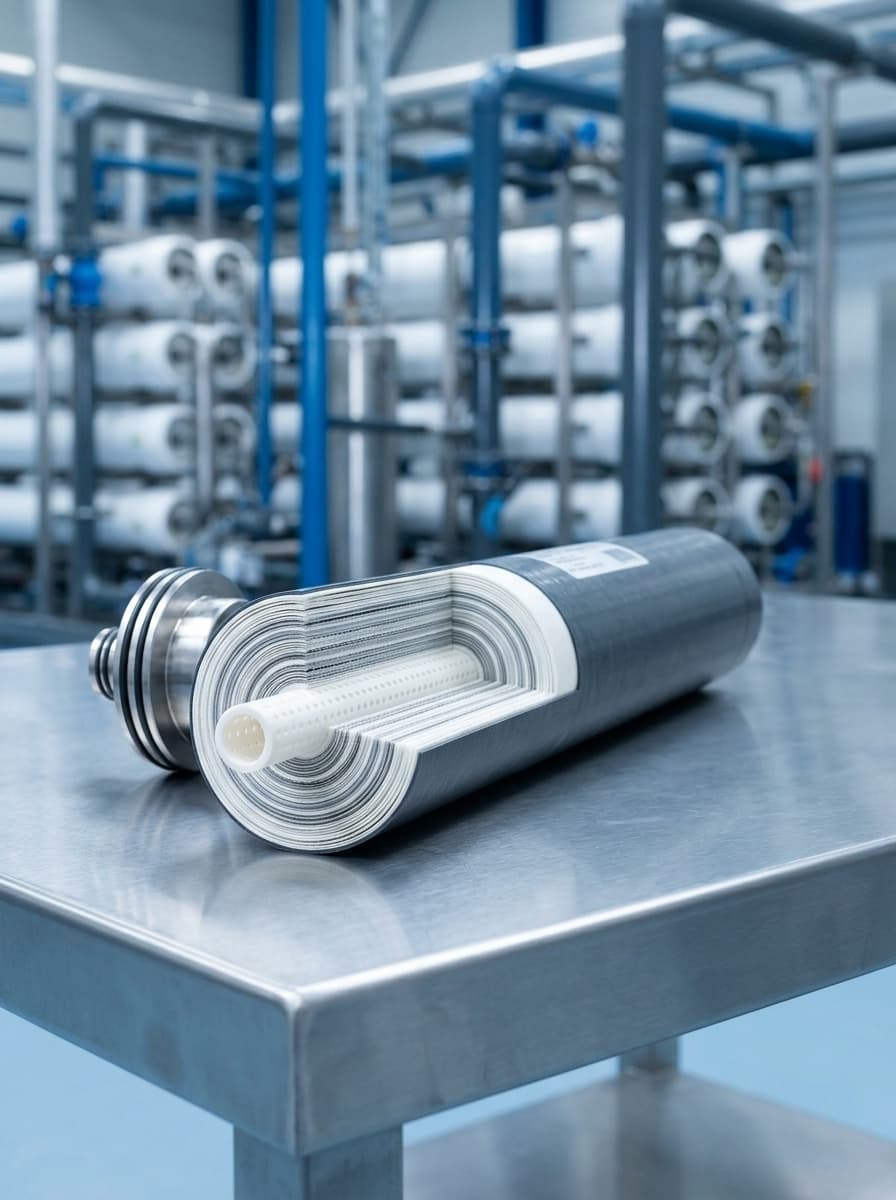
Reverse osmosis membranes are consumable components. They degrade with use, and once performance falls away the right answer is usually a professional assessment and a planned replacement, not a chemical scrub. At Sovereign Water we supply, install and maintain RO systems across commercial sites in Kuwait and the wider GCC, and we see the same pattern again and again: the sites that get the longest, most reliable life from their membranes are the ones with correct pre-treatment and proactive servicing in place.
This matters even more in Kuwait than in most markets. Feed water here is often a blend of desalinated supply, brackish sources and tanker deliveries, with total dissolved solids (TDS) that can vary site to site and season to season. High TDS and warm feed temperatures work membranes harder, which makes monitoring and pre-treatment the difference between a membrane that lasts years and one that fails early.
How a reverse osmosis membrane works
An RO membrane is a semi-permeable barrier that separates dissolved salts from water by forcing pressurised feed water through it. Clean water, the permeate, passes through; a concentrated reject stream carries the salts to drain. Inside a commercial element the membrane is wound in a spiral around a central permeate tube, with feed water flowing across the surface rather than straight through it.
Engineers judge membrane health using three normalised measures: permeate flow, salt passage and pressure drop. Normalising simply corrects the readings for temperature and pressure, so a genuine change in the membrane can be told apart from a change in operating conditions.
Why membranes degrade
Four mechanisms do most of the damage:
- Scaling, when hardness minerals concentrate past their solubility limit and crystallise on the surface, a constant risk on high-TDS Kuwait feed water.
- Fouling, as sediment, colloids and organic matter accumulate and block flow paths.
- Biofouling, where bacteria colonise the surface, accelerated by warm water temperatures.
- Chemical attack, most commonly chlorine from municipal disinfection reaching a membrane that should have been protected by an upstream carbon stage.
Warning signs to watch
Industry guidance puts useful numbers on the thresholds. A widely used trigger is a 10 to 15 percent fall in normalised permeate flow, a similar rise in salt passage, or a similar increase in pressure drop against the commissioning baseline. In practice that shows up as less product water, rising product TDS and longer production cycles.
If performance has drifted that far, cleaning may recover some of it, but on most commercial systems the honest economics favour planned replacement: cleaning chemicals, downtime and labour often cost more than a scheduled element change, and a cleaned membrane rarely returns to full rejection.
Prevention beats cure
The cheapest membrane is the one you protect:
- Correct pre-treatment: sediment filtration, carbon for chlorine, antiscalant or softening matched to the feed analysis.
- Routine monitoring: log flow, pressure and TDS weekly so drift is caught early.
- Planned servicing: filters changed on schedule, not on failure.
Frequently asked questions
How long does a commercial RO membrane last?
Typically 2 to 5 years with correct pre-treatment. On unprotected high-TDS feed water, sometimes less than a year.
Can I clean my own RO membrane?
Light cleaning-in-place is possible on larger plant, but it needs the right chemicals, flow rates and pH control. For most commercial sites a professional assessment is safer and usually cheaper than a failed experiment.
What is the most common cause of failure?
Inadequate pre-treatment. Chlorine attack and scaling, both preventable, account for most early failures we see.
Sovereign Water designs, installs and maintains RO systems across Kuwait, with planned membrane replacement built into our Comprehensive Maintenance plans. If your RO output is drifting, request an assessment and we will test the system end to end.